At 102, Marshall Allen embarks on an ‘Audio Odyssey’
Marshall Allen’s new album, ‘101: An Audio Odyssey,’ is a beast of a record that reflects Allen’s decades of listening and creating from the vanguard of jazz’s creative possibilities.
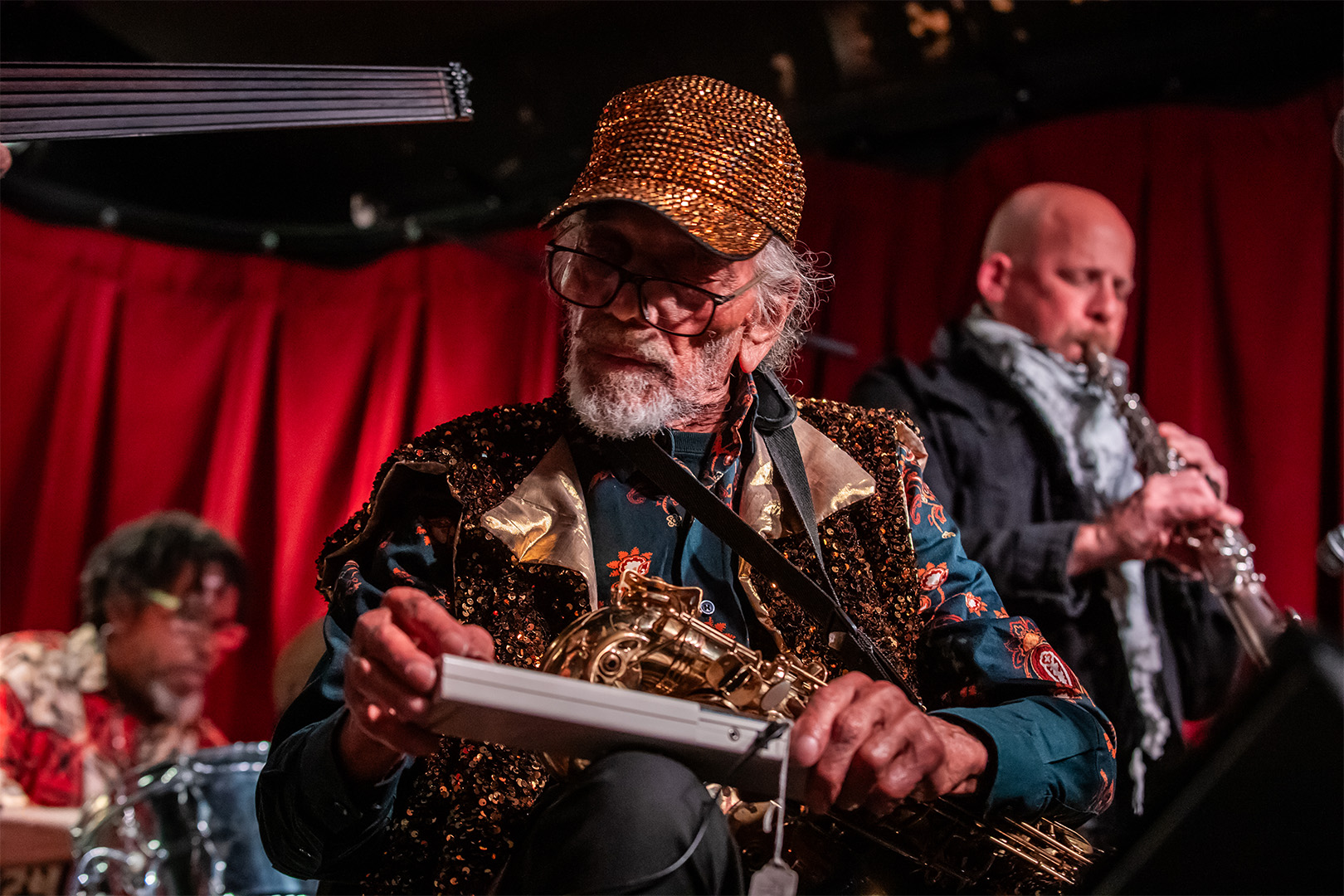
At 102 years old, saxophonist and multi-instrumentalist Marshall Allen has lived more life than most people. As the current leader and longest-tenured member of the Sun Ra Arkestra, Allen is the steward of one of the oldest active musical outfits in jazz. While his work with Sun Ra—first as mentee, then as successor—has taken him around the world and back again, Allen’s extraordinary life as a journeyman did not begin on Sun Ra’s bandstand. 101: An Audio Odyssey is Allen’s latest album and a document of a life spent playing the music of the cosmos.
A colorful and endlessly creative release, 101 traverses the lines between funk, free-jazz, and fusion, striking a unique admixture that sounds like Miles Davis’ electric experiments, filtered through the expansive harmonic and melodic language of Sun Ra. Allen and the Arkestra hold down the center of this sonic mosaic, but they get crucial support from guests including Jamalaadeen Tacuma, Nels Cline, Immanuel Wilkins and more. The result is a daring beast of a record that reflects Allen’s decades of listening and creating from the vanguard of jazz’s creative possibilities.
In late March 2024, I had the pleasure of taking part in the weekend-long celebration of Allen’s 100th birthday. Culminating in a private, invite-only party at Solar Myth in South Philly, musicians and music appreciators from around the world descended on the city of Philadelphia to honor one of jazz’s great living institutions. That Friday, Allen and the Arkestra convened at Rittenhouse Soundworks, a recording studio located about 10 minutes from the Sun Ra house on Morton Street. Allen and the band were there recording tracks for New Dawn, the 2025 album that inexplicably served as the 100-year-old’s debut solo record. Following a Saturday night concert at Union Transfer, I spent the day at the Sun Ra house, interviewing Allen for The Wire, getting insight into his long and extraordinary life.
While Allen was born in Louisville, Kentucky in 1924, he came to Philadelphia in the late 1930s to live with his father in North Philly’s James W. Johnson projects. When World War II broke out in the fall of 1939, scores of young men nationwide enlisted to fight overseas. When Allen was old enough, he joined the 92nd Infantry Division of the United States Army. Known as the “Buffalo Soldiers Division,” the 92nd was the only all-African American infantry division to serve in combat in Europe at the time. While stationed at a military base in Heidelberg, Germany, Allen played with both the military marching band and as a member of a jazz ensemble that played on the radio every night to entertain the troops. From there, Allen was stationed in Paris, and when the war ended, he went to study clarinet with the renowned classical musician and educator Ulysse Delécluse at the Paris Conservatory of Music. It was clear that even at this early stage, music would be a vehicle to carry Allen through some surprising twists and turns in his life.
After a brief stint playing in Europe with jazz legend James Moody, Allen jumped on the SS Nassau cruise liner headed for America. Upon arriving in America, Allen took up residence in Chicago. At the time, the city was bursting with potential and creativity, and Allen got to know the town and its rich musical community by attending and playing in local jam sessions. It was at one of these jam sessions where Allen would meet the man whose music would change the trajectory of his life. Like Allen, the life of pianist, composer, and bandleader Sun Ra was radically changed by World War II. Whereas Allen volunteered to go off to war, Sun Ra refused, declaring himself a conscientious objector. While Allen found himself playing music in Europe, Sun Ra was sent off to a work camp in Marienville, Pennsylvania as punishment for refusing to adhere to military conscription. When Allen turned up at one of Sun Ra’s jam sessions, the two men’s divergent destinies would become inextricably linked. After being recruited into Sun Ra’s band by genius saxophonist John Gilmore, Allen embarked upon a partnership that would carry him to stages around the world. This tutelage lasted until Sun Ra’s death in 1993, and today, Allen is here in Philadelphia, holding the title of the Arkestra’s elder statesman. In addition to performing and recording under the Sun Ra Arkestra banner, Allen has assumed the role of keeper of Sun Ra’s extensive body of music. At times, Allen will add his own new compositions and unique arrangements to the Sun Ra songbook, and in the case of 101, he creates new music that honors the Sun Ra legacy.
From its outset 101: An Audio Odyssey is the closest parallel in the Sun Ra recorded catalog to 1978’s electrified jazz-funk epic Lanquidity. Where 101 parts ways with that album and most of the Arkestra’s music is in the thick, muscular groove of songs like “Funky Robot” and “Cosmic String Slinger.” Tacuma’s bass shines throughout these tracks while Allen conjures some truly inspired textures with alto saxophone and electric wind instrument. On July 18, 101 was presented as part of a live event within Salvador Jimenez-Flore’s exhibition “Raices & Resistencia.” The exhibition, which uses visual art to explore Jimenez-Flore’s bicultural identity, is a fantastic complement to Allen’s broad and winding music and life story. It takes a fair share of circumstance, luck, and divine protection to reach a century of life on Planet Earth. At this point, Allen’s longevity is not just a statistical aberration; it is a gift. As a steward of some of the greatest music ever created, every instant of Allen’s storied life is a living connection to an old and grand tradition.
Related Content
View All