
Streets of Philadelphia is Nick Millevoi’s love letter to the city
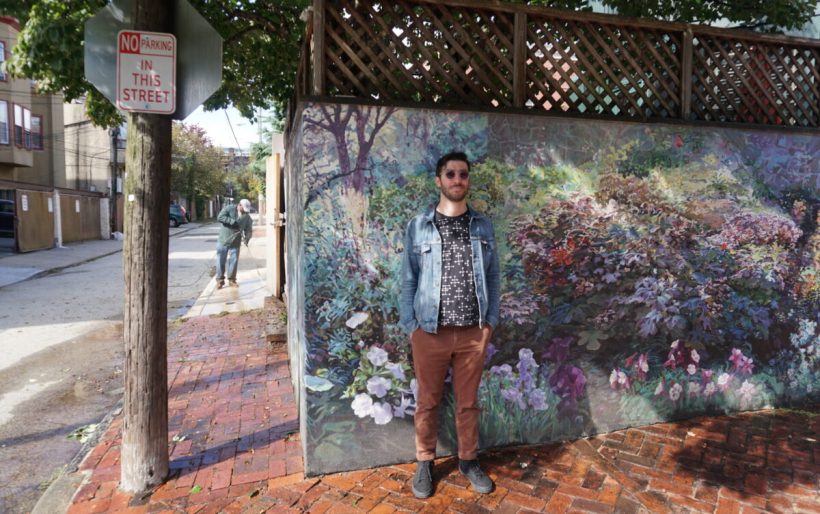
Nick Millevoi | photo by Yoni Kroll for WXPN
If you were writing a Philadelphia-themed album and decided to poll a hundred random residents of the city to find out what they think is an appropriate topic for a song, you’d certainly get a lot of cheese steaks, Grittys, Eagles, Ben Franklins, and snide comments about local politics. While these are all very valid Philly subjects, guitarist Nick Millevoi, a lifelong resident of the city, had a different idea: what if he wrote a hundred tunes and named them all after individual streets. And what if, instead of recording them as an album, he instead printed the notation as a songbook for other people to play.
Thus was born the Streets of Philadelphia project. The first volume of songs, designed by local artist Erik Ruin, was released in conjunction with a series of concerts with different musicians in varied configurations all playing Millevoi’s tunes. The second of those shows is tonight at Pageant : Soloveev at 6th and Bainbridge and the final one is on November 9th, also at Pageant.
We recently traveled with Millevoi to three of the locations mentioned in the first book of songs – Buist, Clay, and Wilder streets – and talked to him about the songs, his own history in the city, and what it means to him to be a Philadelphia musician.

Buist
We started off our trip at the corner of Buist and Island Avenues in Southwest Philadelphia, a part of the city Millevoi referred to as “sort of the alternate reality version” of where he grew up in the Northeast. Although both neighborhoods have a boulevard running through them – Roosevelt in the Northeast and Island in the Southwest – they don’t seem to have that much in common otherwise, at least not on paper. The relationship between the two for Millevoi comes from his own family history: while he lived in the Far Northeast until moving out to the suburbs when he was a teenager, his maternal grandfather Tom McCauley, who he was very close to, grew up in Southwest Philly.
“We would drive around Philly and he would tell me all these stories about places he grew up [and] bars he drank in,” Millevoi said. “He would tell me all these stories about Southwest Philly but growing up in the Northeast I had literally no connection to Southwest Philly.”
When he was 19 and a student at Temple, his grandfather took him on a tour of “all the places he could remember living” in Philadelphia. While Millevoi doesn’t remember them all – “I wish I’d written everything down, because now I just have vague ideas,” he told The Key – that did help spark his initial interest in Philadelphia geography and cartography.
So many of the locations in his grandfather’s history remained vague until Millevoi moved to West Philly as an adult and these places he heard about years earlier began popping up in his day-to-day life.
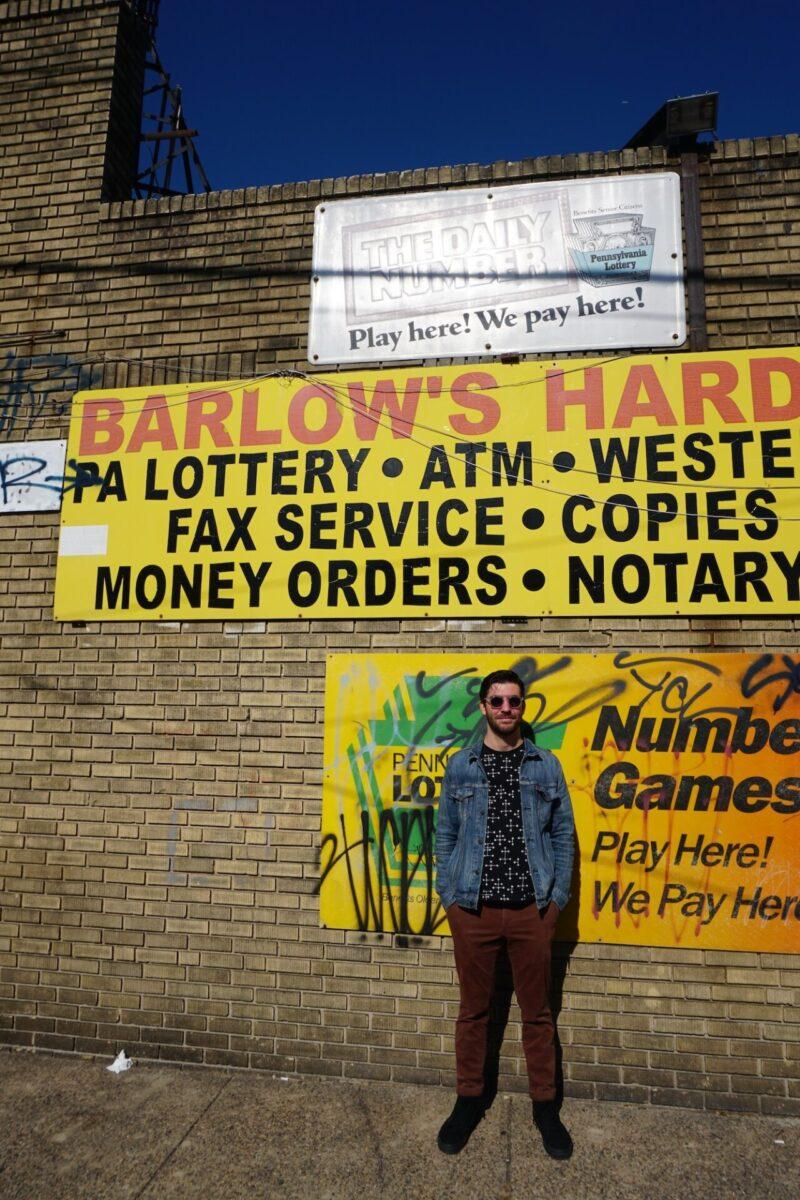
Well before the Streets of Philadelphia project, Millevoi put together a map of, as he put it, “all the stories that I grew up hearing.” So when picking street names for songs he already had a couple he knew he had to use, Buist being at the top of that list.
The process for putting this all together is twofold: street names, which are of course important, but also creating the melodies and arrangements for the songs. Millevoi told The Key that he’d like there to be a hundred Streets of Philadelphia tunes by the time he’s done. “I wanted to write a hundred melodies that were intuitively generated,” he said. “So they were all things that I had improvised or just came up with. Nothing contrived. No thoughts about like how it would be played, why it would be played. It was just, like, ‘Here are these things and this is what I’ll name them after.’ But I specifically didn’t want to have the names first because I thought if I had the names first that would ruin that intuitive process.”
Because there are no lyrics, it would be near impossible to convey any kind of history in the songs, but Millevoi’s aim was more to match what was going on musically to his own feelings and intuitions about the locations. He also tried not to look up information about the streets until after a song got its title.
“With everything else I do it goes either way. Maybe I write the song first, maybe I come up with the name and have an idea,” he explained. But with this, “I didn’t want to know what the meanings of the words were, I wanted to know what the words meant to me. That’s part of the intuition: I have my own thoughts of what ‘Buist’ as a word means to me. It’s this place I didn’t know until I was an adult but I heard about a lot. All these stories about this thing with no visual of it. So it’s sort of this obscure thing that I then put with this sort of obscure sounding melody.”

But even if a song does not go into the full history just the act of naming it after a physical location certainly focuses the listener’s attention on that place. There are 25 tunes in the first iteration of the Streets of Philadelphia, from “Albion” in the Northeast to “Yewdall” in Southwest. While Millevoi stressed that he doesn’t have a close personal connection to most of the streets he used for names, it’s undeniable that taken as a whole this is very much a love letter – and a map – to the city where he’s lived his entire life.
Clay
The second stop on our Streets of Philadelphia tour was on Clay Street, a couple blocks south of Eastern State Penitentiary in Fairmount. This part of Clay, between 21st and 22nd, is more an alley than anything else, with a collection of backyards and parking spots abutting the narrow road.
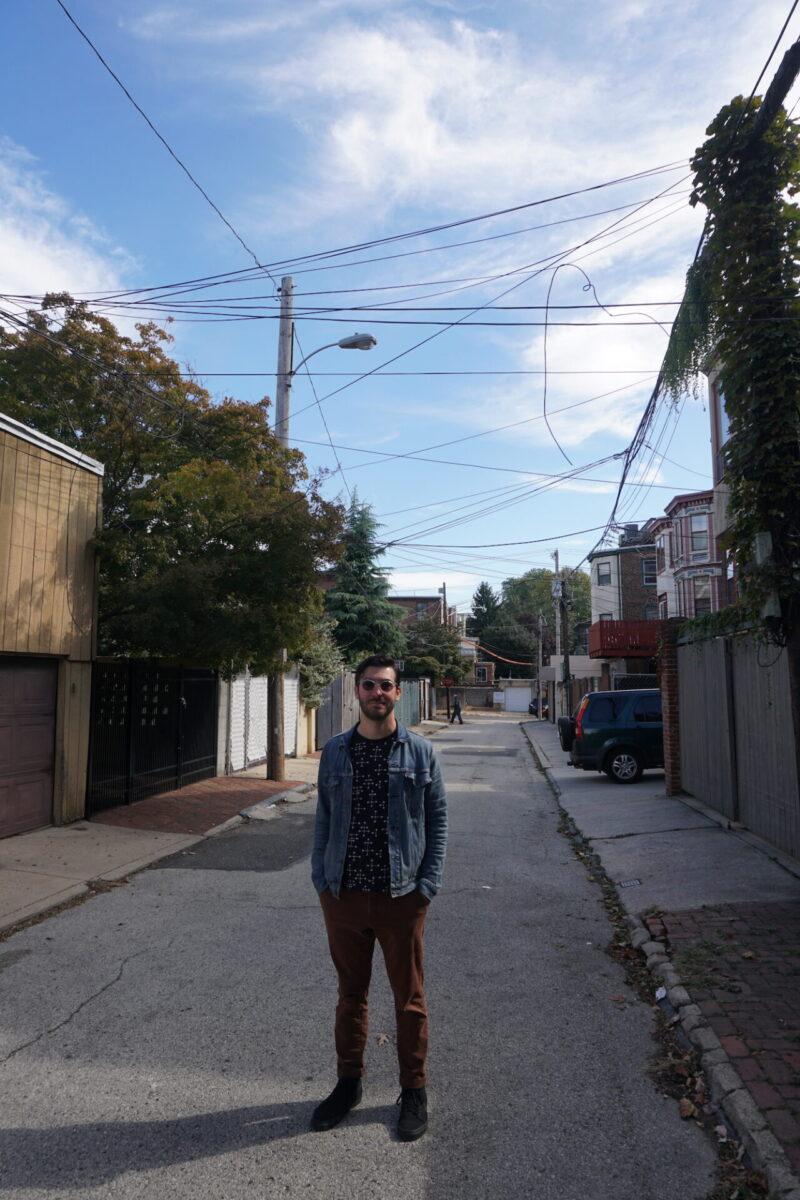
Clay was chosen specifically because of its name, Millevoi told The Key. But standing on the corner he had the realization that the looks of the street fit the song, too. “I like streets that are primarily alleys,” he said. “Looking at the back of houses is interesting. There’s a lot of details to check out: all these houses are more different than the fronts of the houses and they’re kind of compelling in an improvised kind of way. … I’m really digging on it, I’m vibing on that because it really works with my purpose for picking the name ‘Clay.’”
He described the song as a homage of sorts to a record of the same name by Japanese pianist Yosuke Yamashita that he explained is, “named Clay after Muhammad Ali, after Cassius Clay, and the record has various clips of Muhammad Ali talking shit that lead into them starting their improvisations, starting their rhythms off of Muhammad Ali talking shit. One is him hitting speed bag [mimics noise of punches hitting a bag] and they start with that rhythm and it fades in and they’re just ripping this rhythm along with him hitting this speed bag and then they go into really brutal fast free jazz.”
That album was something he got into a few years back with his band Many Arms. “My personal influences that I was trying to push and that I was getting into with what I was writing for the band [were] specifically some minimalism stuff and some post-minimalism stuff and then some really maximal Japanese free jazz,” he said.
What’s interesting about “Clay” is that while he sees the song as being this one specific way, “So far other people have played this one and sent me recordings of them playing it that’s totally not like maximalist Japanese free jazz tributes. I think that’s interesting because it is just a melody that I wrote that was like supposed to be this open thing but once I put this name on it I knew what it meant to me. That’s the way now I hear that melody as relating to this thing.”
That is the nature of a project that exists both as a set of songs in Millevoi’s repertoire but also a series of melodies for others to interpret. This didn’t start as a songbook but rather with him posting videos to Facebook of what he was working on at the time.
“When I posted those I was, like, ‘Anybody who wants to see these can see these. Don’t be shy.’ I didn’t really know what that was going to lead to,” he said. “I don’t really know how many links I sent out but people I didn’t know were hitting me up [for the sheet music.] It was just a PDF and I hadn’t even gone through and edited this stuff so it was a little rough.”
Millevoi has recorded and released tons of albums over his more than decade-long career but it’s the interactions others had with the music that he wanted to hear when it came to the Streets of Philadelphia tunes. “I wrote a quick little thing that just said, ‘Play these things and if you do it send me a video. Let me hear it, I’m interested. And like, here’s how you play them.’ I just sent them into the world and now I have all these videos of people playing them,” he told The Key. “It’s a thing I want to see in the world and that’s why I decided to make it into a book because that’s also something I want to exist.”
While releasing a book of sheet music is a throwback to the days before recorded sound, it’s certainly not unheard of in modern times. “This came about as this thing that already had a life of its own,” he explained. “And I wanted it to exist in print. I wanted Erik [Ruin] to do a design for it. I had a vision for what this physically could do. Otherwise it could have lasted as a digital project completely and it would have been super cool and I’d be fine with that.”
While the crowd for this kind of thing might not be huge, it certainly exists. As Millevoi put it, “It gets smaller as you get more specific about the project. Okay, here’s the thing that exists only as a book and you have to play it to hear it. It’s named after things in Philadelphia. They’re like chromatic melodies of complicated rhythms. Everything limits the audience by like quite a bit. But, you know, adventurous people still exist.”
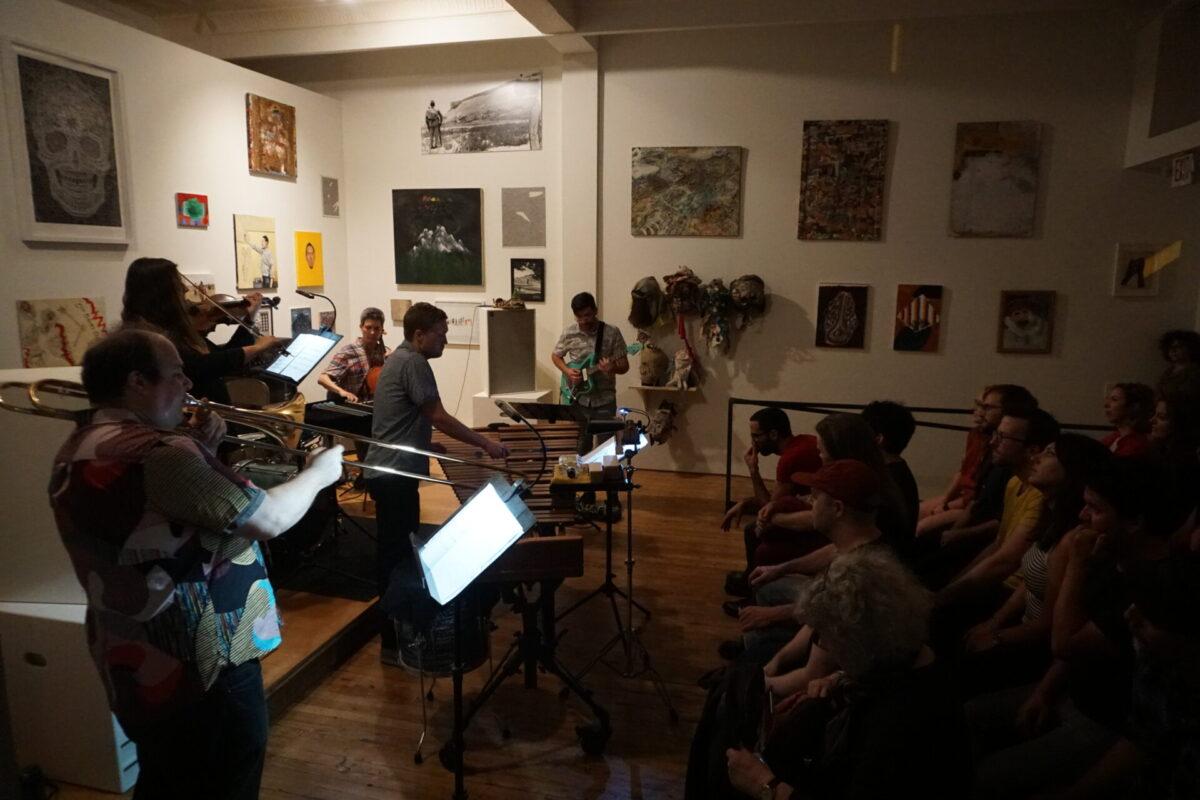
Even if the target population for the book is pretty specific, the music itself has a wide appeal, as could be seen at the packed show the Streets of Philadelphia Chamber Ensemble and Desertion Trio played at Pageant:Solaveev on Bainbridge last month.
The tunes in the book are meant to be more suggestions than anything else. To play them live in a full band – or even solo, depending on the instrument – the musician has to arrange the songs, add in chords and dynamics, and so on. “I thought putting chords in the book would be limiting,” Millevoi said. “But for our set I’m the band leader so I put chords in. But they’re unpublished chords. Because that’s how we play it. But everybody else should do it their own way.”
Though he’s thought of moving – he’s in New York City to play a show a few times a month on average – no other place has held Millevoi’s heart in the same way as Philly, for better or worse. “I’ve tried to move out of here and for whatever reason I still live here because there’s so many things I love about it,” he said. “But when I thought about moving it was not coming from a place of love. It was coming from a place where I felt like I couldn’t fucking deal with living in this place anymore.”
That love/hate relationship with the city is an integral one both to him and really to all Philadelphians. For Millevoi, Philly itself has a certain sound, which is something he has tried to instill in these songs: “There’s a lot of rhythms, they’re really dense with notes. At times some of them are kind of enigmatic. Some of them are pretty and melodic. And some of them are really harsh. All my feelings about this city are in there.”
Wilder
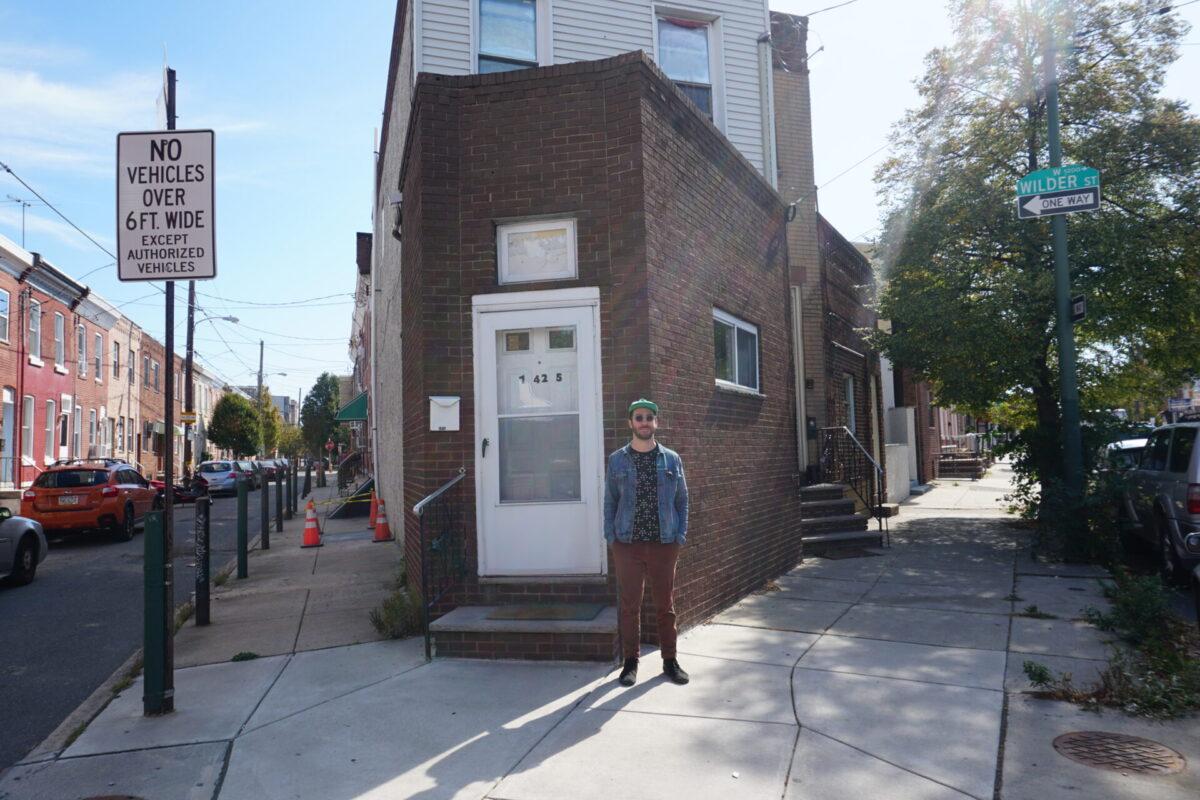
The final stop on our tour was Wilder Street in South Philly. That’s pronounced not how it looks but as if it rhymes with ‘builder’ or ‘gilder,’ which was something Millevoi was keen on figuring out when we arrived at this narrow one-way diagonal between 12th and Dickinson.
With Philadelphia’s long history there are lots of street names that might not be pronounced as they look, if they look like they can be pronounced at all (I’m looking at you, Schuylkill). For Millevoi it’s important to be able to know how the street names are actually said aloud by the people who live on them. “[It’s] saying the words as street names, not as English words or whatever they happen to be. This to me is Wilder [ed. note: as in ‘more wild’] and I’m thinking of it as Wilder but I have a suspicion that it is Wilder [wil-dər, as in ‘bewilderment’]. But I don’t know for sure.
During our interview he conducted an informal poll of passerby, most of whom were unsure of the pronunciation until an older woman who had just exited her home on the corner confirmed Millevoi’s suspicions.
“This was my example of how words are pronounced differently and my infatuation with the Philadelphia accent,” he explained. “Not even just the accent but just like pronunciation and esoteric things about Philadelphia that I find really interesting. We were talking about my grandfather earlier. He had all sorts of weird ways to say things that don’t exist anymore.”
Millevoi brought up a recent WHYY article about the Philly accent and why it’s been fading. He told The Key that the linguist quoted in the piece, Betsey Sneller, “says that the death of the Philly accent began specifically, like super specifically, because ‘we have students who went to magnet schools and were born in 1983.’ Which is me. And my friend who sent me this article. And Dan Blacksberg. We are all students who went to magnet schools and were born in 1983. And I think it makes sense. I definitely have things I say that are like accented. But we have different accents than people we know who went to public schools or went to Catholic schools.”
While his accent is not super strong it’s certainly there. He said that he notices it coming out more when he’s speaking to other born-and-bred Philadelphians or just when he’s talking about the city.
“Wilder Street exemplifies my fascination with how things are pronounced,” he said. “One of the one of the things about Philly that’s interesting and quirky is there are a lot of weird street names.” He explained that for the songbook he stayed away from the more straightforward and obvious names – “I’m not looking for clarity” – instead going for ones that were more open to interpretation in some way or another.
“Wilder” was chosen as a title because Millevoi thought it was “wilder than other streets” and that worked thematically with the song’s melody. The fact that Wilder starts off east-west and then goes diagonal at 12th “fit this one tune where I wanted it to intentionally always be performed where each phrase is played differently,” he told The Key.
Does that now change because he discovered it’s pronounced differently than he originally believed? Not really.
In the same way he eschewed obvious song names, Millevoi has certainly embraced the chaos and confusion of the city. While Philadelphia might exist on a grid, you don’t have to go more than a few blocks to find something that is completely out of place. “I think that’s a thing that I find so appealing and quirky,” he said. “How I relate to it [musically] is with weird atonal melodies, chaotic rhythms, and stuff like that. But then there is some sort of plan to it all.”
In other words: “I named [a song] ‘Wilder’ as if it’s wilder and then I realized that, like, I bet it’s not Wilder.” But also, street names, like song names, like animal names, imbue the thing in question with certain personality traits that might not be there to begin with. As Millevoi put it, “Names take on their own thing. It’s just random. So it’s best not to be overly specific about [naming] because the music and the name just have to learn to live with each other.”
When choosing the names for the songs Millevoi used old maps that are hosted on the Free Library website. While he said that “the end result would have been the same” had he been using something like Google Maps, “I want to think that in whatever way that transfers into the music.” Referencing outdated maps also resulted in him stumbling across the incredibly-named Point-No-Point, which existed in Bridesburg decades ago before it was incorporated into another street, and naming a song after it.
While matching up songs to street names might seem random, it is what Millevoi referred to as a “curated randomness” that creates associations between the two. He brought up a recent concert in Knoxville where Mike Baggetta, a guitarist who is performing at the second Streets of Philadelphia show, played a solo set of songs from the book and how weird it felt to him. “It is so out of my control now,” he said, laughing. “That’s sort of this trippy experience that I hadn’t realized I might have to think about. Now it’s taken on its other meaning that really might have nothing to do Philadelphia.”
Still, it feels impossible to divorce the songs from whatever they’ve taken on both for Millevoi and the people playing this music. “I gave it meaning. I put a title on it,” he told The Key. “So everybody knows where they’re coming from. And now there’s thoughts and intentions about Philadelphia out there.”
Philadelphia has always been overlooked. It’s the underdog trope, sure, but it’s also true. So to have a project like this that puts the city on a pedestal, warts and all proudly displayed, feels like the most Philly thing Millevoi can do as both a musician and as a Philadelphian. We might not be other cities, but “there’s stuff here that is important, too. That is happening, that has happened, and that could happen if we just push it a little bit more,” he said. “And so this is my way of pushing that into that world. Like, here’s some Philly shit. This is my version of that. Somebody else can do their own Philly thing. But there’s music happening here. There’s been music happening here.”
